
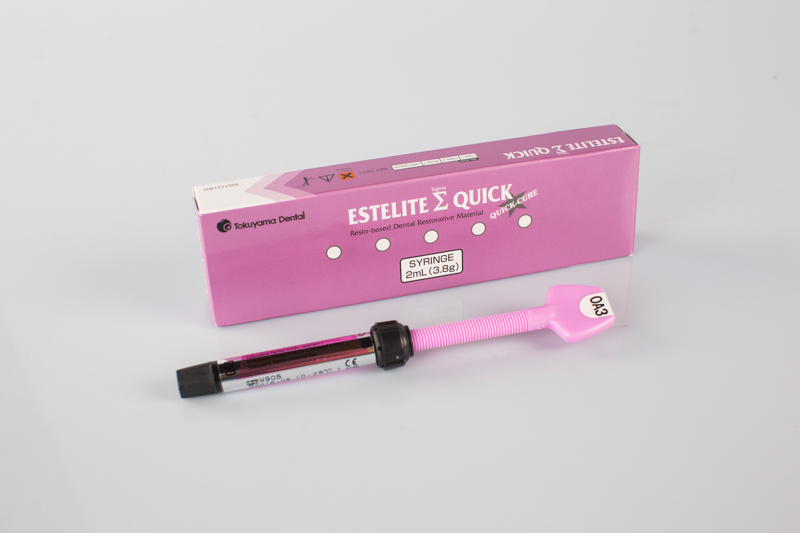
Estelite Sigma Quick Restorative Composite, Syringe 3.8 g (Tokuyama, Japan)
Enamel shades: A1, A2, A3, A3.5, A4, A5, B1, B2, B3, B4, C1, C2, C3, CE, WE.
Designed for the final layer of the restoration, mimicking enamel. They add depth to the restoration's color and help reproduce the halo effect. Due to their high translucency, they exhibit the most pronounced chameleon effect. If the desired shade is unavailable, they can be easily substituted with a close shade.
Used independently within the dentino-enamel junction (DEJ). In cavities extending below the DEJ, enamel shades are combined with dentin shades.
Specific translucent zones in the tooth, such as the incisal edge, cusp tips, and enamel ridges, can be imitated with CE (Clear Enamel) or WE (White Enamel) – for bleached or primary teeth. CE (Clear Enamel) is also referred to as Incisal, as it is often used to simulate the translucency of the incisal edge.
Opalescent shades (dentin): OA1, OA2, OA3, BW.
These shades have optical density closely matching dentin shades and are recommended for restoring the dentin layer in moderate and deep cavities. They are the primary shades that establish the color foundation of the restoration.
BW (Bleach White) is recommended for restoring bleached teeth. It is the lightest and most opaque of all opalescents. The optical properties of BW – high white pigment saturation – effectively block "greyness" when restoring through defects. BW can be successfully used to mask dark dentin in non-vital teeth, resorcinol-formalin staining, metal posts, etc.
Opaque OPA2
Optically the densest shade, corresponding to A2 on the VITA shade guide. In most cases, a single 1.5-2.0 mm layer of OPA2 applied to the palatal surface is sufficient to provide the desired level of opacity to the entire restoration. OPA2 should not be extended to the buccal surface or used to restore the entire missing dentin – the restoration would appear more saturated and brighter than the natural tooth structure. OPA2 effectively neutralizes discolored areas; a 0.5-1.0 mm layer serves as an excellent masking agent.